Master-Child Copy Trading
Auto-copy orders from one master account to many child accounts, best for orders from an algo or placed on your broker's terminal.
- Orders are auto-copied from one master account to one or many child accounts.
- Place, modify or cancel in the master and the same action is copied to every child account.
- Each child has its own quantity multiplier.
- A child can follow more than one master, each master with its own multiplier.
- One rule: a single account cannot be both a master and a child.
- Best for orders from an ALGO, or placed in the master on your broker's terminal. Trade by hand and want more control over every account? Use PMS Copy Trading.
On this page
- What is copy-trading?
- Why our copy-trading is better
- How to set up copy-trading
- How master and child accounts can be linked
- Quantity multiplier, order splitting and the freeze limit
- How to stop auto-copy
- How to modify or delete a master account
- How auto-copy works
- Which segments are copied?
- Using a master account that is already connected to another algo
- How to monitor auto-copy progress (TRACE)
- How to auto-split orders past freeze limits
- Limitations and precautions
- Error scenarios and solutions
- Performance
- Delay
- Why the execution price differs between master and child
- Testing
What is copy-trading?
Copy trading means copying orders automatically from one trading account (called the master account) to one or many trading accounts (called child accounts). Master-child is one of the two methods in our copy trading software for Indian brokers.
There are two ways to do copy-trading in our system. The difference matters, so read PMS vs Master-Child before you choose.
- Master-Child Copy Trading — best for orders that come from an “ALGO”, or when you prefer to place orders in one master account on your broker’s terminal.
- PMS Copy Trading — recommended for manual traders who want more control over every account they copy into.
Videos
How-to video (16 min): the full setup on the real screen. Every setting on the Master Accounts screen, an order placed in the master and followed by the children, the Copy Log, why an order is sometimes not copied, and the two most common mistakes.
New to master-child? The concept video (5 min) explains the idea first, with simple diagrams: one master account, child accounts that follow it, each with its own quantity multiplier, and the golden rule of trading in the master account only.
Comparing Master-Child with placing one order from our screen (PMS)? See PMS copy vs master-child. More videos: Video guides.
Why our copy-trading is better
- Easy to set up
- Automated order copying
- Copies place, modify and cancel operations smoothly
- Quantity multiplier for each child account
- Auto-split to place orders beyond the freeze limit
- Automatic rounding of quantity based on lot size
- Rapid execution of orders, which means less slippage
- Lets you set a start and end time for copying
- Easy on/off switch to stop or start copying
- Full master and child order details for each copied order
- In-depth copy logs for complete transparency
- All child accounts copied at the same time, never one account after another
- Several master orders copied in parallel too, for higher throughput
- Optional sequential mode for option traders who need the order sequence preserved
- Built-in protection against infinite copy loops
How to set up copy-trading
Pre-requisites
- Register for AutoTrader Web. See User Registration.
- Add your trading accounts in the system. See Trading Accounts.
- Create pseudo accounts (optional — you also get the option to create a pseudo account while creating a trading account). See Nicknames.
Master-Child setup
There is no “Child Accounts” menu — and that is expected. The menu has Group Accounts and Master Accounts only. A child is not a separate kind of account: it is just one of your normal trading accounts that you attach to a master. So you always do it in two steps:
- Add the child account itself under Accounts → Trading Accounts, exactly the way you add any broker account.
- Attach it to a master under Accounts → Master Accounts — create a master, or open an existing one, and add that account as a child on the child-selection screen (step 4 below).
If an account is missing from the Available Accounts list in step 4, it is almost always because it has not been added under Accounts → Trading Accounts yet, or because it is already used as a master somewhere — one account cannot be both a master and a child.
-
Go to menu (Accounts -> Master Accounts).
-
Click the Create button.
-
Select the Master Account (the orders of this account will be auto-copied) [Screenshot 1, see below].
-
Click Next to select Child Accounts [Screenshot 2, see below]. The settings on this screen are:
- Copy Placement — enables copying of order placement.
- When ON and a new order is placed in the master, it is copied to child accounts.
- Turn it OFF to stop order copying.
- When you turn it OFF and save, Copy Cancellation and Copy Modification turn OFF with it. So cancels and changes of earlier orders are not copied either.
- Copy Cancellation — enables copying of order cancellation.
- When ON and an order from the master account is cancelled, all of its copies in the child accounts are also cancelled.
- Turn it OFF to stop order cancellation copying.
- Copy Modification — enables copying of order modifications.
- When ON and an order from the master account is modified, all of its copies in the child accounts are also modified.
- Turn it OFF to stop order modification copying.
- Parallel Order Execution — decides whether several master orders are copied at the same time or one after another.
- Keep it ON for most scenarios, as it gives better performance. It is ON by default.
- Only if you are an option trader who wants orders executed in a proper sequence to avoid margin shortfall errors, keep it OFF.
- This setting does not change how a single order reaches your child accounts. One order always goes out to all of its child accounts at the same time, whether this setting is ON or OFF. The setting only decides the order in which several master orders are handled.
- Please read the sequential order execution limitations below.
- Auto Split Frozen Qty — automatically splits the order if the order quantity is higher than the freeze limit (the maximum single-order quantity allowed by the exchange). See Quantity multiplier, order splitting and the freeze limit below.
- Segments to Copy (the segment filter) — lets you copy orders for selected segments only.
- All segments (cash, F&O and commodity) are ticked by default.
- Untick a segment, and the master’s orders in that segment are skipped.
- If you untick every box, nothing is filtered: orders in all segments are copied.
- Copy Duration — controls the time window when copying is active in your account.
- Outside this window nothing is copied: no new order, no modification and no cancellation.
- An order placed in the master before the start time is never copied, not even after the start time.
- Copy Start Time — copying starts at this time. Default is 9 am (change it as needed).
- Copy End Time — copying ends at this time. Default is 15:40 (3.40 pm), which matches the F&O market close. Change it as needed, especially if you also trade in the commodity segment, which closes later. See Market timings.
- Important: This is very useful for intraday traders. Set this value to a time before your broker’s intraday auto-square-off process begins. If you do not, AutoTrader Web may copy intraday auto-square-off orders placed by your stock broker. Many brokers now start the intraday square-off earlier, from around 3.10 pm. Please confirm the exact time with your broker.
- Available Accounts — a table of all accounts available to be added as a child account.
- Click the Plus (+) button in the first column to add the account as a child account.
- Child Accounts — a table of the accounts you have added as child accounts.
- Quantity Multiplier — you can edit the quantity multiplier. It can be from 0.01 to 10,000. See Quantity Multiplier for calculation and rounding details.
- Careful with a multiplier below 1. With one lot in the master, a multiplier like 0.3 makes the child quantity zero lots, and that order is rejected (“Invalid quantity: 0”). Choose a multiplier that gives the child at least one lot even on the master’s smallest order.
- Live — every child must be Live. A child that is not Live gets no orders, and no error is shown for it.
- Click the Minus (-) button in the first column to remove the child account.
- Copy Placement — enables copying of order placement.
-
Click the Save button to save the new master-child configuration.
Once you save the master account, the system starts copying as per the parameters you have set.
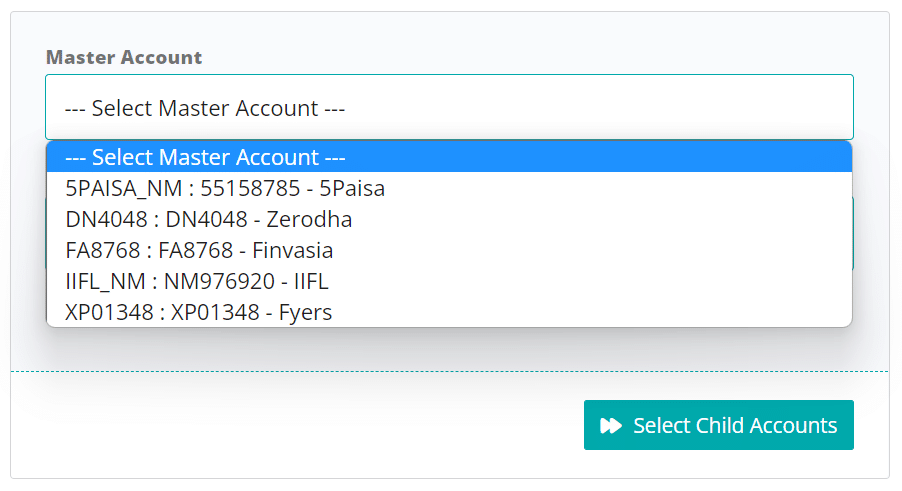
1. Select Master Account
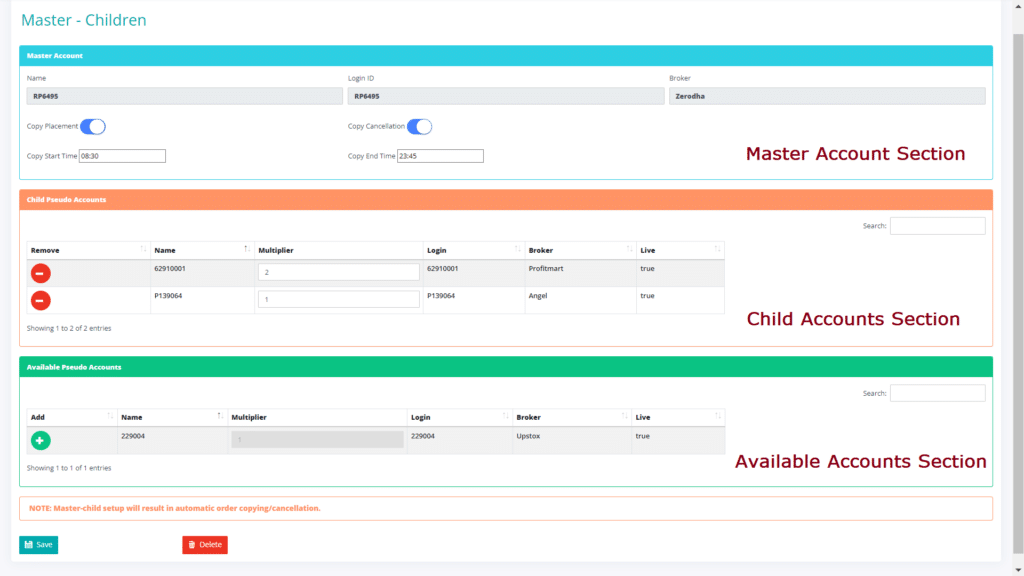
2. Select Child Accounts
How master and child accounts can be linked
You are free to link master and child accounts in whatever shape suits you. Both directions are allowed:
- One master, many children. Add several child accounts under a single master. Every order from that master is copied to all of its children.
- One child, many masters. The same account can be a child of more than one master. To do this, simply add it as a child under each master (repeat the setup for each master). Each master then copies its own orders into that child. The child has its own quantity multiplier under each master, and each master keeps its own copy settings (copy start/end time, segments and so on), so you control every master separately.
This is useful when you want one account to follow the trades of two or more different strategies or algos at the same time.
The one rule: an account cannot be both a master and a child. An account that acts as a master (it has children of its own) cannot at the same time be a child of another master, and the other way round. This prevents an endless copy loop. So an account that follows more than one master must itself be a plain child — not a master of anything.
Important — all masters share the same child account. When a child follows more than one master, every master’s orders land in that one broker account. Their positions add up and net together there, just as if you had placed them yourself. So make sure the child account has enough margin for all of its masters together, and set each link’s multiplier with that in mind. Test with small multipliers first.
Quantity multiplier, order splitting and the freeze limit
These settings control how much quantity each child trades and how very large orders are handled. They work a little differently here than in PMS Copy.
Quantity multiplier (per child). Each child account has its own quantity multiplier. The master order’s quantity is multiplied by the child’s multiplier to get that child’s quantity. Set it in the Child Accounts table while setting up the master (see above).
On a derivative the multiplier is applied to the number of lots, and the result is rounded to the nearest whole lot. A result that lands on exactly half a lot rounds up, never down. So if you set a child account to 1.5, a master order of 1 lot fires 2 lots in the child, 2 lots fire 3, 3 lots fire 5, 4 lots fire 6 and 5 lots fire 8 — an odd number of lots always rounds up, so the child takes slightly more than 1.5 times the master, not less. For the full calculation and the setting that controls it, see Quantity Multiplier.
Cash and commodity orders are not rounded to lots: the quantity is simply multiplied.
A multiplier below 1 can make the quantity zero. With a multiplier of 0.3 and 1 lot in the master, the child gets 0.3 lots, which rounds to zero lots. An order with zero quantity cannot be placed, so that child’s copy fails with “Invalid quantity: 0”. Choose a multiplier that gives the child at least one lot even on the master’s smallest order.
Try it with your own numbers — change the base quantity or any child’s multiplier and watch each account resize:
Change the base quantity or any multiplier and watch each account resize. The numbers behave exactly as they will on a real copied order.
- Account B asked for half of 11 lots. Half a lot cannot be traded, so it is rounded to 6 lots — the multiplier works on lots, never on the raw quantity.
Reading this with JavaScript off? The table above is the worked example: a base quantity of 330 on a contract with a lot size of 30 — that is 11 lots. A multiplier of 1 sends 330, a multiplier of 0.5 sends 180 (6 lots, because 5.5 lots is rounded up), 1.5 sends 510 and 2 sends 660.
Freeze limit. The Indian stock exchanges cap the maximum quantity allowed in a single order. This cap is called the freeze limit and it is different for each contract. An order larger than the freeze limit is rejected by your broker — this can happen when a child has a high multiplier.
Order splitting (per master). To place a quantity beyond the freeze limit, turn on the Auto Split Frozen Qty toggle on the master account. The system then breaks a large order into smaller orders that each stay within the limit. It is OFF by default — see how to auto-split orders past freeze limits below for the details and cautions.
How to stop auto-copy
To pause copy trading for a while — a few hours, or the rest of the day — and turn it back on later, use the one-click button (Option 1). You do not need to delete the master account; your master and child links and settings stay exactly as they were while it is paused.
Option 1 — quick on/off button (best for a short pause)
- Go to menu (Accounts -> Master Accounts).
- Click the master account row to select it, then click the Disable Copy button at the top. Copying stops right away.
- To start copying again later, select the row and click the Enable Copy button.
- Note: Enable Copy turns on all three switches: Copy Placement, Copy Cancellation and Copy Modification. This happens even if you had turned cancellation or modification off before. If you want one of them off, open the master, untick it again and click Save.
Option 2 — untick Copy Placement
- Go to menu (Accounts -> Master Accounts).
- Click on your master account name in the first column.
- Untick the Copy Placement switch to stop auto-copy.
- Click Save.
- Copy Cancellation and Copy Modification turn off with it, so cancels and changes are not copied either.
When you turn copying back on
- Only what you do in the master after that is copied.
- Orders you placed, modified or cancelled in the master while copying was off are not copied to the child accounts.
- Example: you cancel a master order while copying is off. The child’s copy stays open. Cancel it in the child account yourself if you don’t want it.
How to modify or delete a master account
- Go to menu (Accounts -> Master Accounts).
- Click on your master account name in the first column.
- To delete, use the button at the bottom.
- To modify, you can:
- Add or remove child accounts
- Update the quantity multiplier
- Enable or disable copy operations
- Modify start and end time, etc.
- Click Save.
Renaming the master or a child account is safe. A nickname rename changes only the name. The master-child link, each child’s quantity multiplier, your copy settings and any risk management rules stay the same. If you place orders only in your broker’s own app, there is nothing else to update. Rename outside market hours, then open this screen and check the master, its children and the multipliers.
How auto-copy works
Once the set-up is complete, you are all set to do auto-copy.
- The system keeps monitoring your master account for any new orders.
- As soon as it sees new orders, it copies them to the child accounts automatically.
- Orders can be placed in the master account from these sources:
- AutoTrader Web — Trade Screen or APIs.
- Directly in your stock broker’s own app, website or terminal, or through APIs (via algos) — see the limitations below for this case.
When a new master order is NOT copied. A new order in the master is copied only if all of these are true:
- Copying is on for the master (Copy Placement is ticked, and copying is not disabled).
- The order was placed inside the copy window (Copy Start Time to Copy End Time). An order placed before the start time is never copied later.
- Its segment is ticked under Segments to Copy.
- It is a regular order of today, not an after-market order (see the limitations below for other order types).
- We see it within 3 minutes of its order time. If the master’s broker login had dropped, or the broker’s order book was down for a while, an order older than 3 minutes is not copied later. This is so that no order goes out at an old price.
Only children that are Live get the order. A child that is not Live is skipped, with no error.
Place the order in the master account only. Do not pick the master and its child accounts together.
- If you pick the master and its children together on the Trade screen (for example with “select all”, or a group that holds both), or in Review & place on the Options screen, each child gets the order twice: once from you, and once more from copy trading.
- The app now warns you before placing, and offers to remove the child accounts for you.
- The same applies to square-off. If you square off the master and its children together (for example with Sq-off Acc and all accounts selected), each child is closed by you, and then the master’s square-off order is copied into it as well. That opens a new position in each child. Square off the master only and copy trading closes the children, or turn copying off first and then square off all accounts. The app warns you here too, and offers to square off the master only.
- Want to place into many accounts yourself, with no copying? That is PMS copy. Then do not set those accounts up as master and children, or turn copying off for that master.
Note on rejected and failed orders. Copying is triggered only by an order appearing in the master account’s order book. Whatever shows up there is copied — no matter its status (open, complete, cancelled or rejected). The deciding factor is visibility in the order book, not whether the order succeeded: some brokers show rejected or failed orders in the order book, and for them those orders are copied; other brokers do not put rejected orders in the order book at all, and for them a rejected order is not copied. Because this differs from broker to broker, use PMS copy if you want full control over exactly which orders get placed.
Do not forget to monitor the progress.
Which segments are copied? (commodities included)
Copying is not limited to any market segment. Master-child copy watches the master account’s order book and copies any order that appears there — stocks (cash), futures and options, and commodity contracts. There is no special setup to copy commodity orders. See Are commodity contracts supported? for the full list of what the platform supports.
Two settings matter if your master trades commodities:
- Copy End Time — the default (15:40) matches the F&O market close. The commodity segment trades until late evening, so extend the end time or your commodity orders after 15:40 will not be copied. See Market timings.
- Segments to Copy — make sure the commodity segment is ticked on the master. All segments are ticked by default.
Also make sure each child account has the commodity segment enabled at its broker, or the child order will be rejected by the broker.
Using a master account that is already connected to another algo
Many users already run their own algo, a purchased algo, or a third-party algo platform on the same account they want to use as the master. That works well — your algo keeps placing orders in the master account and we copy each of those orders into the child accounts.
There is one thing to check first. Both systems have to stay connected to that broker account at the same time: your algo needs one connection and AutoTrader Web needs another. Brokers allow this in one of two ways.
- More than one API key. Some brokers let you create more than one API key (or more than one API app) for the same account. Use one key for your algo and a separate key for AutoTrader Web. This is the cleanest setup, because the two never touch each other.
- More than one login on the same API key. Some brokers allow the same API key to be logged in from more than one place at the same time. This also works — your algo uses one login and we use the other.
If your broker allows either of these, there is no problem.
If your broker allows neither — only one API key, and only one login on it — then this will not work. Every new login logs the earlier one out. Your algo logs in and we get logged out; we log in and your algo gets logged out. The two keep knocking each other offline, and the results of both your algo and copy trading become unpredictable.
So please check with your broker which of the two they allow before you set this up. For more detail, see Can I use my broker API key in more than one app?.
How to monitor auto-copy progress (TRACE)
Important: Monitoring the progress of auto-copy is essential. Many variables and systems are involved, so errors can happen at times. Keep a close watch and take action if needed.
Monitor from our PMS dashboard
Our PMS dashboard lets you monitor all of your trading accounts from one place. Go to menu (Trading -> Portfolio) and start monitoring.
- Look for every new order placed in your master account (by you or your algo).
- Then check whether it has been copied properly into all of the child accounts.
Order copy details
To see how a master order was copied to your child accounts, use the Copy Log link:
- Go to menu (Trading -> Portfolio) and open the Orders tab.
- Find the master account order. On master accounts, a Copy Log link is shown next to the order (it also has its own Copy Log column — if you cannot find it, scroll to the right or drag the column to the front).
- Click Copy Log to open the complete details of the copy operation [Screenshot 3, see below].
- You can check every child order id on this screen.
- If you have any doubt about the execution of child orders, copy the order id and check the child order details in our Orders tab or your broker’s trading terminal order history screen.
- For even more detail, the Copy Log screen also shows the server activity logs of the copy operation [Screenshot 4, see below].
Check the Copy Log the same day, before midnight. The Copy Log link sits next to the order in the Orders tab. After the day ends, the broker resets the order book, so the order no longer shows, and neither does its Copy Log link. If something went wrong, take a screenshot of the Copy Log that same day.
The Copy Log screen also has a Timing & Performance Details panel. It stays closed when the screen opens, so the copy details tables stay in front of you. The total time of the copy is printed on the panel itself. Click the panel to open the Timing Statistics section. It shows every stage of the copy, each with its own timestamp, so you can see exactly where the time went. All times are in seconds.
- It starts when your master order reaches us, then shows your order details being read, the first child order being sent, and your broker confirming it.
- When more than one child order is copied, it also shows the slowest child order separately, so you can spot the one that lagged.
Below this is a per-child table. For each child order it shows when the order was sent and confirmed, plus three time columns:
- Our system — the time spent on our side.
- Broker system — the time taken by your broker (including network time).
- Total Time — the two added together.
Click the small help icon inside any of these cells to see a full stage-by-stage breakdown. This makes it easy to see whether a delay was on our side or at your broker.
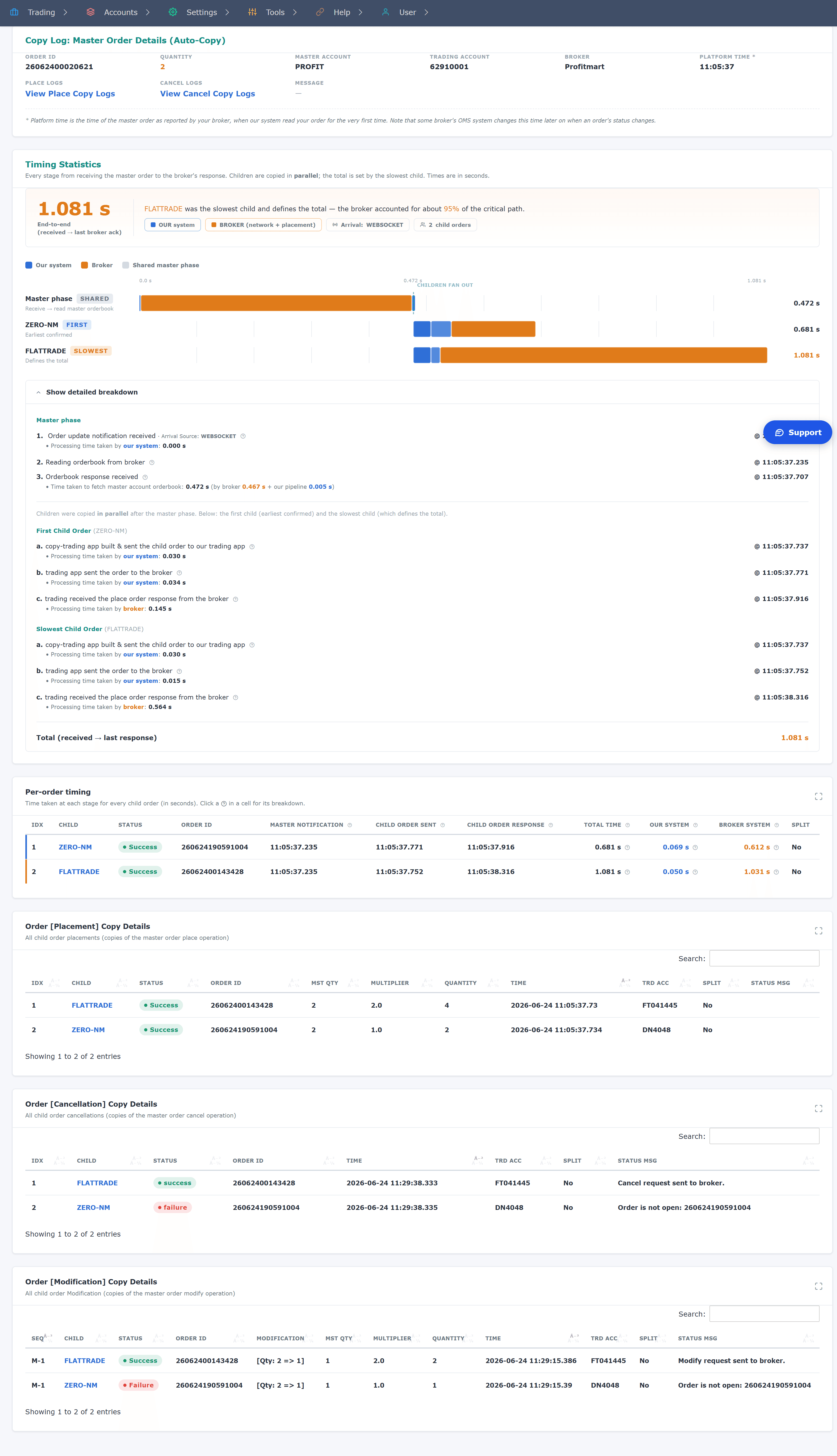
3. Copy Log details
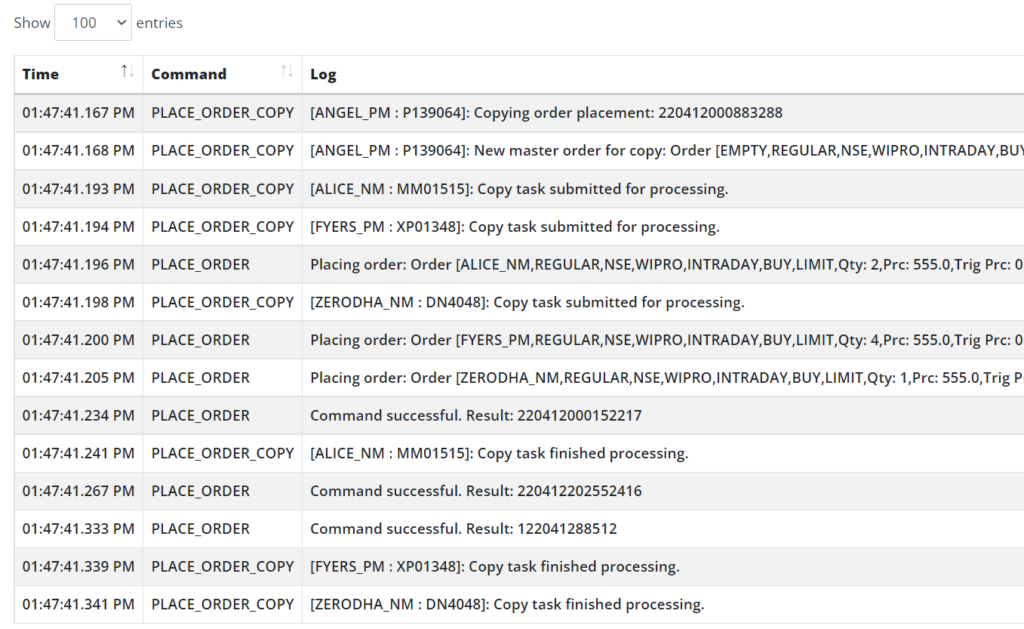
4. Order copy server activity logs
For any support query or issue on copy trading, please mail your investigation (Copy Log and activity log screenshots). Without it, we cannot provide assistance.
How to auto-split the order (to overcome quantity freeze limits)
If a child account has a high multiplier and the resulting order quantity goes beyond the freeze limit set by the exchanges, your order will be rejected by the broker.
To help with this, the system can automatically split the order if the quantity is higher than the freeze limit.
How the split is calculated
The system does not divide the quantity into equal parts. It fills each order with as much quantity as the freeze limit allows, and the last order carries whatever is left over:
- Each split order is as large as possible while staying within the freeze limit.
- The final order holds the remainder.
Example — freeze limit 5,000:
- A child order of 6,000 becomes 2 orders: 5,000 + 1,000.
- A child order of 12,000 becomes 3 orders: 5,000 + 5,000 + 2,000.
Derivatives (lot size). For futures and options, the split works in two steps:
- The total is brought down to a whole number of lots first. If the child quantity is not a whole number of lots, it is reduced to the next lower whole number of lots.
- Then it is split. Each order is the largest whole number of lots that fits within the freeze limit, and the last order holds the rest — which is also a whole number of lots.
If the freeze limit is smaller than a single lot, the order is not split; it is sent as it is and your broker handles it. A quantity smaller than one single lot is never reduced to zero — it is sent as it is, so you get a clear message from your broker instead of nothing happening.
Why the total is brought down. Every order sent to a broker must be a whole number of lots. Earlier, only the split orders were checked, so the leftover in the last order could be an invalid quantity — the earlier orders went through and the last one was rejected, leaving you with part of the position you asked for. Bringing the total down first means every order is valid, at the cost of placing a little less than you asked for — always less than one lot.
The freeze limit is a quantity, not a number of lots. It is set per contract, so you have to convert it yourself to know how many lots fit. For example, on a contract with a lot size of 65 and a freeze limit of 1,800, only 27 whole lots fit (27 × 65 = 1,755), so each split order carries 1,755 and the last order carries the rest as whole lots. Limits this large mean a small multiplier rarely triggers a split at all.
Splitting is not about margin. Splitting only keeps each order within the exchange freeze limit. Apart from bringing the total down to a whole number of lots, it does not reduce the quantity, so the child account still needs enough margin for the order. If a child cannot afford the copied quantity, lower that child’s multiplier — see Quantity Multiplier.
Note: By default, auto-splitting is turned off. Placing orders of large quantities is risky, so only users who need it should enable it.
Important: By enabling auto-splitting, we assume you understand the risks. Do thorough testing by keeping less margin in child accounts before going ahead with actual trading.
Note: If a child’s order was auto-split and you then change the quantity of the master order, that child’s modification is not copied at all — not even a price or trigger change made at the same time. (Changing it could cause a freeze limit error.) A change of price or trigger alone is copied as usual. Quantity will NOT auto-split when master order quantity is modified. In such cases, cancel the master order and place a new order in the master account with the new quantity.
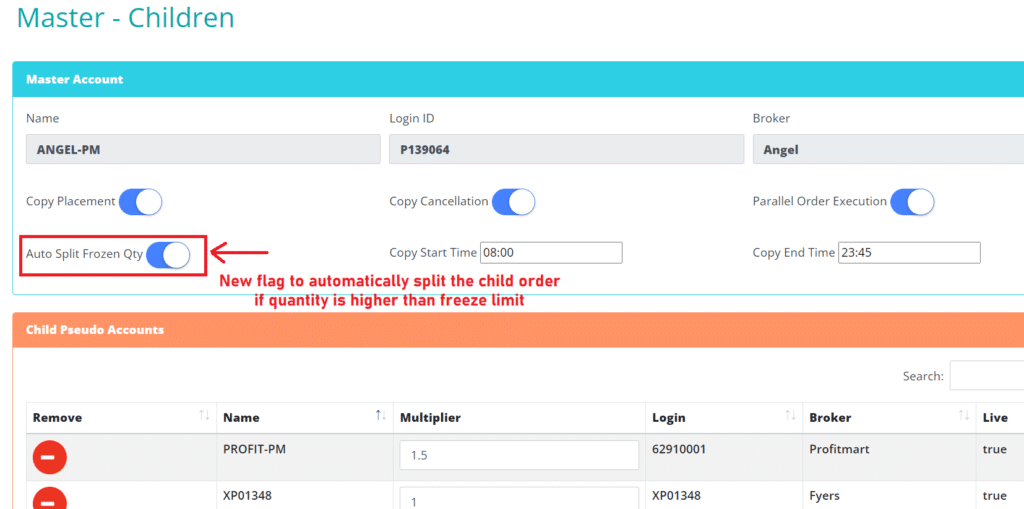
Auto split frozen qty – Flag
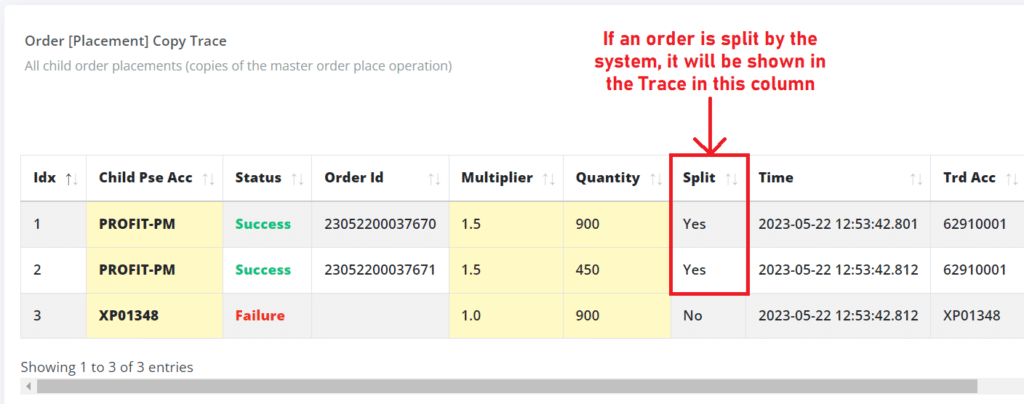
Split column in the “Trace” window indicates if an order was split
Limitations / Precautions
These are known limitations of the system. You are strongly advised to read and understand them.
- Testing — A very common mistake: many users enable auto-copy for testing and then forget to disable or delete it. If you do not want to use auto-copy after testing, disable auto-copy or delete the master account.
- Only orders visible in the master’s order book are copied — rejected ones included, but only if your broker shows them there. Copying is based on the master account’s order book, not on whether the order succeeded. Any order that appears in the order book — including a rejected or failed one — is copied to the child accounts, regardless of its status. But some brokers do not put rejected orders in the order book, and for those brokers a rejected order is not copied. As this varies by broker, use PMS copy if you need full control over what is placed.
- AMO (After Market Orders) are not supported in master-child copy. They are supported in PMS copy — place the AMO once there and pick the accounts, so use PMS if you trade with after-market orders.
- Bracket and Cover orders (BO and CO) are not supported in master-child copy. PMS copy supports them where your broker does.
- GTT orders are copied only when they trigger. A GTT that is still waiting is not copied. When it triggers, it becomes a normal order in the master account, and that order is copied like any other.
- Converting a position on the master (for example, intraday to normal) is not copied to child accounts. Copy trading copies orders, not positions. Convert the child positions yourself if you need to.
- Iceberg orders are not supported in master-child copy. Only regular orders are auto-copied. If an iceberg order is placed in the master account, it is skipped and nothing is copied to the child accounts. There is no partial copy and no repeated small orders.
- Orders in a master account can be placed directly on broker platforms.
- A master account that is also used by another algo — your broker must allow either a second API key or more than one login on the same API key. If it allows only one API key and only one login, your algo and our system will keep logging each other out and both will behave unpredictably. See Using a master account that is already connected to another algo.
- Quantity Rounding is ON by default. Do not turn it OFF without proper understanding. Read more about Quantity Rounding.
- A price change is copied only if the change in price is greater than 0.01 (1 paisa). This is due to decimal precision issues with some brokers.
- Quantity Modification Copy — Quantity will NOT auto-split when master order quantity is modified. When you modify the quantity of an open master order, the system copies the quantity modification to children, with the multiplier applied. Take extra care that the child account’s multiplier-applied quantity stays within allowed limits (the quantity freeze limits set by the exchange). If the child’s order was split, or its new quantity would need a split, that child’s modification is not copied at all (not even the price). In such cases, you should cancel the master order and place a new order in the master account with the new updated quantity.
- Intraday auto-square-off
- Intraday traders should know the auto-square-off timings of all brokers of master as well as child accounts they trade with.
- Set copy end time to be earlier than the earliest (minimum) auto-square-off time of your brokers.
- Intraday positions should be squared off by you or your algo before the copy end time.
- If you do not, the auto-square-off orders placed by your broker in the master account get copied to child accounts (not something you want).
- IIFL and 5paisa Broker
- It is NOT recommended to use an IIFL account as a master account.
- Only order placement copying is supported for an IIFL master account.
- Order cancellation copying is not possible for an IIFL master account.
- Once you cancel an IIFL order, the broker changes that order’s unique order id.
- AutoTrader Web uses the order id to find all of the child orders.
- Because IIFL changes the master order after it is cancelled, the system cannot find the child orders and so cannot cancel them.
- If the master order is cancelled (which changes its order id), you also will not get correct trace and logs.
- If an IIFL account is a child account, there is no problem.
- It is NOT recommended to use an IIFL account as a master account.
- Sequential order execution
- This applies only if you have turned Parallel Order Execution OFF on the master account. With it ON (the default), your orders are copied at the same time and none of the points below apply.
- Sequential order execution uses the order timestamp to sort the orders.
- If the order timestamp given by the broker is the same for two or more orders, the order of execution is unpredictable.
- Brokers mostly give the timestamp only to second-level accuracy; they do not provide the order timestamp in milliseconds.
- For guaranteed sequential order execution, keep a delay of at least 1.5 seconds between your consecutive orders.
- Trading in a child account
- Be careful if you place orders in a child account. Mistakes like the one below can easily happen without you realizing it. Example:
- You place a buy order in the master account.
- It is copied automatically to children.
- The order is executed and you have a long position in both the master and all of its children.
- You square off the position in one of the child accounts (by mistake or on purpose).
- If you now square off the position in the master account, this happens:
- Because you had a long position, the square-off in the master means a sell order.
- This sell order is copied to all children.
- Now the master and all children (except the one) have the position squared off.
- But the one child account you already squared off now has a short position open. Its net quantity was zero after you squared it off, and auto-copy has placed another sell order.
- Exiting everything at once: square off the master only, or turn copying off first. Squaring off the master and all its children together (for example with Sq-off Acc) does the same as the example above to every child. AutoTrader Web warns you before this and offers to square off the master only.
- Be careful if you place orders in a child account. Mistakes like the one below can easily happen without you realizing it. Example:
- Order Timestamp Comparison
- Users make the mistake of comparing the order timestamp with the order copying time.
- The order timestamp seen on the AT Web orders screen or your trading platform orders section is the last modified time.
- The last modified time is when the order was last modified on the broker’s side. It should NOT be compared with order copy times.
- The correct comparison is with the order entry or created time. You can see this in two places:
- AutoTrader activity logs
- Many brokers provide an order log or order history feature, which shows the order entry time.
- Users make the mistake of comparing the order timestamp with the order copying time.
- Orders are monitored via the orderbook. If your broker’s orderbook API goes down, master-child copying will not work. (PMS copy is not affected — there you place the order in our system, so nothing depends on reading your broker’s order book.) This is extremely rare, as broker APIs are fairly stable.
- The 3-minute rule. A new master order is copied only if we see it within 3 minutes of its order time. If the broker’s order book had a glitch, or the master’s broker login had dropped, an order older than 3 minutes is not copied later, so that no order goes out at an old price. Place such an order in the children yourself if you still want it there.
- Copy window. Outside the Copy Start Time to Copy End Time window nothing is copied: no new order, no modification and no cancellation. If you cancel or change a master order after the end time, do the same in the child accounts yourself.
- A failed child order is not re-sent automatically. If a child’s copy fails (for example, its broker rejects it for margin), place it in that child yourself, for example from the Trade screen.
- Validity across brokers. If a child is with a different broker from the master, an order validity other than DAY or IOC is sent to the child as DAY.
- Risk rules on a child only send alerts. A child account’s risk rule does not square off and does not block orders, because a child that squares off on its own falls out of step with the master. Put your limits on the master: when the master squares off, the children follow. See Risk Management.
- A maximum of 100 modifications are copied for a single order in master-child copy. If the same order is modified more than 100 times, modification copying stops for that specific order. This avoids overload in the system.
- You are strongly advised to do proper testing before going live (see the Testing section below).
- Master-child copy testing should be done in live market hours.
Error scenarios & solutions
Because of the complex nature and the involvement of multiple systems, you may see errors or unexpected behavior at times.
Order place/cancel is not copied into one of the child accounts
- Use our PMS system to manually place or cancel the order in the child account.
- Click on the master order copy trace link (explained above) to understand why the order was not copied.
Orders are not getting copied, or any other issue
- Check the activity logs.
Continuous orders are being fired
- This can only happen if your algorithmic trading system has a bug.
- Go to menu (Accounts -> Master Accounts):
- Click on your master account.
- Untick Copy.
- Save.
Performance
Important: Evaluate copy trading performance only during live market hours. Performance may appear slightly slower outside market hours, and this is intentional by design.
Master-child is a background copy design. Whenever there is a new order in your master account, a notification is sent to us. Copying starts only after we receive that notification.
So performance mainly depends on how quickly your broker sends the new order notification. Most brokers tell us about a new order in 50 to 100 milliseconds, so child order copying starts almost instantly. Brokers without such a quick notification take 0.2 to 3 seconds.
All child accounts are copied at the same time
Once copying starts, every child account is handled in parallel, not one after another. We do not send the order to the first child, wait for that broker to reply, and then move to the second. All of the child orders are prepared and sent together, so one slow broker cannot hold up the other accounts behind it.
Measured across live production over 30 days, this is the gap between the first child account and the last one, at two steps: our own work (turning the master order into every child order), and those orders then reaching each broker.
| Child accounts on the master order | Our own work, all done within | All orders reach the brokers within |
|---|---|---|
| 5 to 9 | 2 milliseconds | 9 milliseconds |
| 10 to 19 | 10 milliseconds | 40 milliseconds |
| 20 to 49 | 22 milliseconds | 170 milliseconds |
Typical (median) values. The second column carries your brokers’ own speed with it, which is why it is larger.
You can see all of this for your own orders in the Copy Log. Open its Timing & Performance Details panel: each child row has its own timestamps, split into Our system and Broker system. More measured numbers are on the speed and performance page.
If your master account fires several orders at once, those orders are also copied in parallel by default. That is the Parallel Order Execution setting on the master account, and it should stay ON for best performance. Turn it off only if you trade option strategies and need your orders to reach the broker in a strict sequence — see Sequential order execution under Precautions above. Turning it off changes the order in which your orders are copied; it does not change the fact that a single order still reaches all of its child accounts together.
High performance (the broker tells us about a new order in 50 to 100 milliseconds):
- AliceBlue
- Angel One
- Dhan
- Finvasia
- Flattrade
- Fyers
- Groww
- IIFL
- Kotak Neo
- Profitmart
- Symphony XTS (all brokers)
- Upstox
- Zebu
- Zerodha (Paid API only)
Normal performance (no such quick notification, so copying starts 0.2 to 3 seconds after the order):
- All remaining brokers, including Choice and Mastertrust
Note on brokers with a free and a paid API. A few brokers sell more than one API tier, and only the paid one sends the instant new-order notification. Zerodha is the example above: with its paid API (₹500 per month, paid to Zerodha) a Zerodha master copies in the high-performance range, and on its free API it falls into the normal range instead. This matters only for the master account. A child account gets no benefit from the paid API, and neither does any account used with PMS copy — there you place the order in our system, so nothing waits for a broker notification. So take the paid API for the master only, and keep the free one everywhere else. The fee is charged by the broker, not by us. See the Zerodha setup page for how to pick the tier while creating your API app.
Note: Master-child copy is optimized to perform better in live market hours, so any performance testing must be done in live market hours only.
Delay
There can be a slight delay in copying at times for brokers with Normal performance (see above). This is expected behavior in any kind of master-child copy. The reason is that any copying system using a master-child design must wait for the new order notification. A user enters an order in the broker’s terminal, then the broker sends a notification of the new order. The copying process starts only after a notification is received.
So the lag or delay in copying depends on how long your master account’s broker takes to notify us about a new order: 50 to 100 milliseconds on most brokers, and 0.2 to 3 seconds on brokers without such a quick notification.
The other copy method we provide, PMS Copy, does not have this limitation. In that method, the user enters the order in our system, so our system does not have to wait for the notification from your broker. Because of this, PMS copy has almost no delay — copying starts immediately.
Broker network speed (IPv4 vs IPv6)
Part of the Broker system time you see in the Copy Log is plain network travel to and from your broker. Some brokers allow API access only from a fixed IP on the older IPv4 network, and providing a fixed IP on that network needs some extra network routing that can add a small delay to each order. Brokers that support the newer IPv6 network do not need this, so for them this delay is negligible.
Investigation of delay
The quickest way to check this is the Copy Log screen (above). Open its Timing & Performance Details panel. It shows these stage timings for you directly and tells you whether the time was spent on our side or at your broker.
To understand if there is a delay, compare the difference between the created_time of the master order and the child order.
The problem is that brokers mostly report the last_updated_time of the order on the orders screen, which is completely different from the created_time.
If you enter an order in the morning and it remains open, then it gets executed in the afternoon, the last updated time column shows the afternoon time. So this last_updated time value should not be compared.
There are two ways to check created_time for an order:
- Check the activity logs (AT Web menu: Tools -> Activity). This tells you the time the order was placed.
- Some broker platforms provide an “order history log” button. Click it to see what time the order reached the broker. The screenshot below shows the Order Log (History) shown by the Zerodha Kite website.
- If you cannot find the order history log on your broker’s terminal, ask their customer care to provide it.
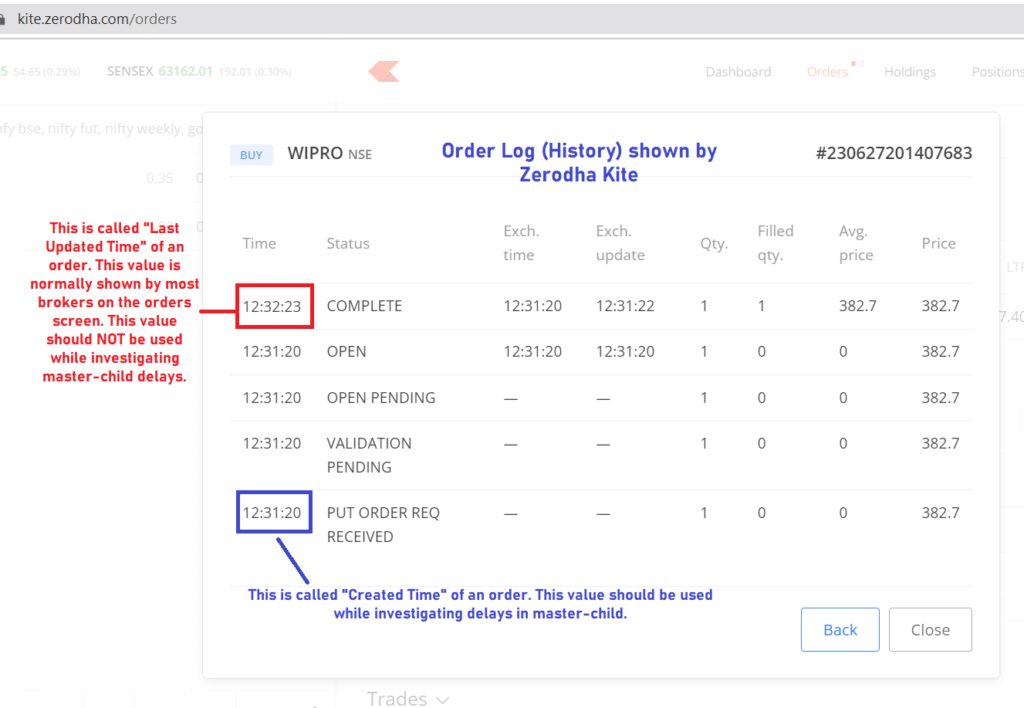
Zerodha Kite – Order Log (History)
Why the execution price differs between master and child
A very common question: my master account filled a market order at one average price, and my child accounts filled at another. Why do they not match?
This is expected, and nothing was copied wrongly. Quantity, symbol, buy or sell side and product type are copied exactly. The price is the one thing that cannot be copied, because it is set by the market at the exact moment each order reaches the exchange — and the child order always reaches it a little later than the master order.
Two things decide the size of the gap:
- How long the child order took to go out. Copying can only start after your broker notifies us of the new master order (see Delay above).
- How much the price moved in that time. Nobody controls this — not us and not you.
There is one more thing to know about market orders specifically. Market orders are not accepted through a trading API any more, so a copied market order is converted into a protected limit order by Market Price Protection. That conversion uses the live price at the moment the child order is sent, not the price the master order filled at. So the child order is always priced against the market as it is at that later moment.
The gap works both ways — depending on which way the price moved, a child account can fill at a better price than the master, not only a worse one.
If you want the same price in every account, place a LIMIT order in your master account. A limit price is a number you choose, so it is not worked out again for each account — it is copied to every child exactly as you set it, and no account can fill worse than that price. (The same applies to a stop-loss limit order: both the trigger price and the limit price copy across unchanged.) The trade-off is the usual one — a limit order fills at your price or not at all, so in a fast move it may fill partly or not at all. A market order buys certainty of getting filled; a limit order buys certainty of price.
If you want to keep using market orders, you cannot control the price movement, but you can control the delay. Put your master account with a high-performance broker, where the new-order notification reaches us in 50 to 100 milliseconds instead of 0.2 to 3 seconds. The child order then goes out much sooner and meets a price much closer to the master’s. If you place orders by hand rather than through an algo, PMS copy removes the notification wait altogether.
A stop-loss market order behaves better than people expect here. It is copied when you place it, not when it triggers, so the child order rests at the exchange alongside the master’s with the same trigger price and both trigger on their own. The copying delay is not in the critical path at all. One difference: by Market Price Protection, the child gets a stop-loss limit order, not a stop-loss market order. Its limit price is set a small buffer beyond the trigger price, so in a very sharp move the child may fill at a different price than the master, or not fill at all.
Full explanation, with worked examples and what to check before reporting a problem: Why is my child account’s execution price different from the master account?
Testing
Follow these guidelines to test the auto-copy feature and reduce risk.
What to test
- Place an order in the master account.
- Make sure it is copied to child accounts.
- Make sure the quantity in child accounts matches the quantity multiplier.
- Cancel an order in the master account.
- Make sure child orders are cancelled.
- Untick the copy flag in the master account and place an order in the master account.
- Make sure the order is NOT copied to children, because you have disabled the auto-copy operation.
After-market testing
- This has the lowest risk, as orders will not be executed on the exchange.
- However, you may face issues such as orders being rejected due to non-market hours.
- You cannot test order cancellation copy this way.
Live market but safe orders
- Enter safe orders that are not likely to execute.
- Example: if a stock or derivative is currently trading at 100/-, place a buy order at 90/- so it remains open.
- Make sure orders are copied as expected.
- Cancel the order in the master account.
- Make sure orders are cancelled in the child account (assuming you have copy cancellation enabled).
Frequently asked questions
Where do I set up a child account? The menu only shows Group Accounts and Master Accounts.▾
That is correct — there is no Child Accounts menu, because a child is not a separate kind of account. It is just one of your normal trading accounts that you attach to a master. Do it in two steps. First add the account itself under Accounts → Trading Accounts, the same way you add any broker account. Then go to Accounts → Master Accounts, create a master or open an existing one, click Next to reach the child screen, and click the Plus (+) button next to that account in the Available Accounts table to add it as a child. Set its quantity multiplier and click Save. If the account is not in the Available Accounts list, it has either not been added under Trading Accounts yet, or it is already used as a master — one account cannot be both a master and a child.
Can one child account follow more than one master?▾
Yes. A single child account can be linked to two or more masters. Just add that account as a child under each master. Every master then copies its own orders into that same child, with its own quantity multiplier and its own copy settings for that child. Keep in mind that all the masters share the one child account — their orders and positions add up there — so make sure the child has enough margin for all of them together. The only rule is that one account cannot be both a master and a child at the same time (this prevents an endless copy loop), so an account that follows several masters must itself be a plain child.
Can a master account also be a child of another master?▾
No. An account cannot be a master and a child at the same time. If an account has children of its own it is a master, and it cannot also be added as a child under another master (and the reverse is also blocked). This rule prevents an endless copy loop. A master can still copy to many children, and a child can still follow many masters — you just cannot chain them.
When a large order is auto-split to stay within the freeze limit, is it divided into equal parts?▾
No. The system fills each order with as much quantity as the freeze limit allows, and the last order carries whatever is left over. For example, if the freeze limit is 5,000 and the child order is 6,000, it becomes 2 orders — 5,000 and 1,000. A child order of 12,000 becomes 3 orders — 5,000, 5,000 and 2,000. For futures and options there is one extra step: the total is first brought down to a whole number of lots, and then every split order is a whole number of lots as well. So the total placed can be a little less than the child quantity — always less than one lot — and in return no order is rejected for an invalid quantity. Apart from that, splitting does not reduce the quantity, so the child account still needs enough margin for the order.
How can I check how fast my orders were copied?▾
Open the Copy Log for a master order (menu: Trading -> Portfolio -> Orders tab -> Copy Log). The total time is printed on the Timing & Performance Details panel. Click that panel to open the Timing Statistics section. It shows how long each stage took, from receiving the master order, to each child order being sent, to your broker confirming it, with a per-child breakdown. It also separates the time spent on our side from the time taken by your broker, so you can see exactly where any delay was. All times are shown in seconds. Copy speed mainly depends on how quickly your broker notifies us of a new order.
How do I know if a copy delay is caused by your system or by my broker?▾
Open the Copy Log for the master order, then click the Timing & Performance Details panel to open the Timing Statistics section. The per-child table has separate Our system and Broker system columns, plus a Total Time. Click the help icon in any cell for a stage-by-stage breakdown. If the Broker system time is large, the delay was at your broker, not on our side.
I cannot see the timing details on the Copy Log screen. Where did they go?▾
They are still there. The Copy Log now keeps them inside a panel named Timing & Performance Details, which stays closed when the screen opens. This was done so the copy result tables (placement, cancellation and modification) are the first thing you see, because that is what most people come to check. The total time of the copy is printed on the panel itself, so you can read it without opening anything. Click the panel to open the full Timing Statistics section and the per-child timing table.
If I place an order directly in my broker's own app, website or portal, will master-child copy trading still copy it?▾
Yes. Master-child copy watches your master account's order book and copies any order that shows up there — whether you placed it in AutoTrader Web, in your broker's own app, website or terminal, or through an algo. It is not limited to orders placed in our software. If instead you want to place each order yourself in our terminal, PMS copy is the method for that.
Why did my child accounts get the same order twice?▾
Most often, the order was placed in the master and its child accounts together, on the Trade screen or in Review & place on the Options screen. The child gets one order from you and one more from copy trading. Place the order in the master account only, and copy trading does the rest. The app now warns you when you pick a master and its child accounts together.
I squared off all my accounts and my child accounts got a new position. Why?▾
The master and its child accounts were squared off together. Each child was closed by you, and then copy trading copied the master's square-off order into it too, which opened a new position. Close those new positions from the child accounts only (orders placed in a child are never copied). Next time, square off the master only and let copy trading close the children, or turn copying off first. The app now warns you before this happens.
If an order is rejected or fails in my master account, will it still be copied to the child accounts?▾
It depends entirely on whether the order is visible in your master account's order book. Master-child copying watches that order book and copies only what appears in it — but anything that does appear is copied regardless of its status (open, complete, cancelled or rejected). So the deciding factor is the order book, not success or failure: some brokers do show rejected or failed orders in the order book, and for them those orders get copied; other brokers do not show rejected orders at all, and for them a rejected order is not copied. Because this varies by broker, use PMS copy if you want full control over exactly what gets placed.
Will a market order copy from my master account to the child accounts?▾
Yes. A market order copies just like any other order. Even though it fills almost instantly, it still shows in your master account's order book as a completed order, and master-child copy sends it to your child accounts from there. Both market and limit orders copy normally — a market order is not skipped for filling quickly. This works across brokers too, so a master at one broker can copy a market order to a child at another broker.
Is there any delay when copying orders, and how fast is copy trading?▾
Master-child copying starts when your master account's broker tells us about the new order. Most brokers tell us about a new order in 50 to 100 milliseconds, so copying is almost instant. Brokers without such a quick notification take 0.2 to 3 seconds. If you want almost no delay, use PMS copy trading instead: there you place the order directly in our system, so there is no wait for a broker notification and copying is near-instant. You can always see the exact time taken for any order in the Copy Log's Timing & Performance Details panel, which also splits the time between our system and your broker.
Are MTF (margin trading facility) orders copied to the child accounts?▾
Yes. An MTF order in the master account is copied to each child account as an MTF order, even when the child is with a different broker. In PMS copy, choose MTF as the product on the Trade screen, and every account you pick gets an MTF order. The child's broker still checks each order: MTF must be turned on for that account, the stock must be on the broker's MTF list, and the account needs enough margin. An MTF sell is rejected if the child account does not hold those shares under MTF. If one child's order is rejected, the other child accounts are not affected.
Are iceberg orders copied from the master account to the child accounts?▾
No. Master-child copy copies only regular orders. If you place an iceberg order in the master account, the system skips it and nothing is copied to the child accounts — so there are no small repeated orders and no cost in the child for it. Bracket (BO), Cover (CO) and after-market (AMO) orders are also not copied by master-child. A GTT order is copied only when it triggers and becomes a normal order in the master account. These limits apply to master-child copy only — PMS copy does support after-market and bracket/cover orders, and for a large quantity it splits the order for you, so switch to PMS copy if you need any of these.
For one large trade, why does my child account place many small orders (higher brokerage), and how do I avoid it?▾
Master-child copy watches your master account's order book and copies each order it finds. A large trade cannot go as one order — it is placed as several orders in the master account, because one order cannot cross the freeze limit — so each child copies all of them, even when a child's smaller total would have fit in a single order. That is why a child with a small multiplier can end up with many small orders and more brokerage. To avoid this, use PMS copy instead. In PMS you enter the quantity once and each account is sized and split on its own quantity, so a small account can place a single order while a larger account is split only as much as its own quantity needs. The trade-off is that PMS orders are placed through our platform (the trade screen or our API), not by an algo sending the order straight to your broker.
Next steps
Thanks for the feedback. Still stuck? Contact support.
Last updated 24 October 2026