Positions
Track live positions and profit or loss across all accounts, and square off or increase in a click.
The Positions tab shows the live status of positions from all your trading accounts in one screen. You can view profit and loss, filter by DAY or NET and by OPEN or CLOSED, search by symbol or account, and square-off one or more positions (or entire accounts) at market price or with custom options. You can also increase (add to) one or more positions in the same direction.
This screen shows the live status of your positions from all accounts.
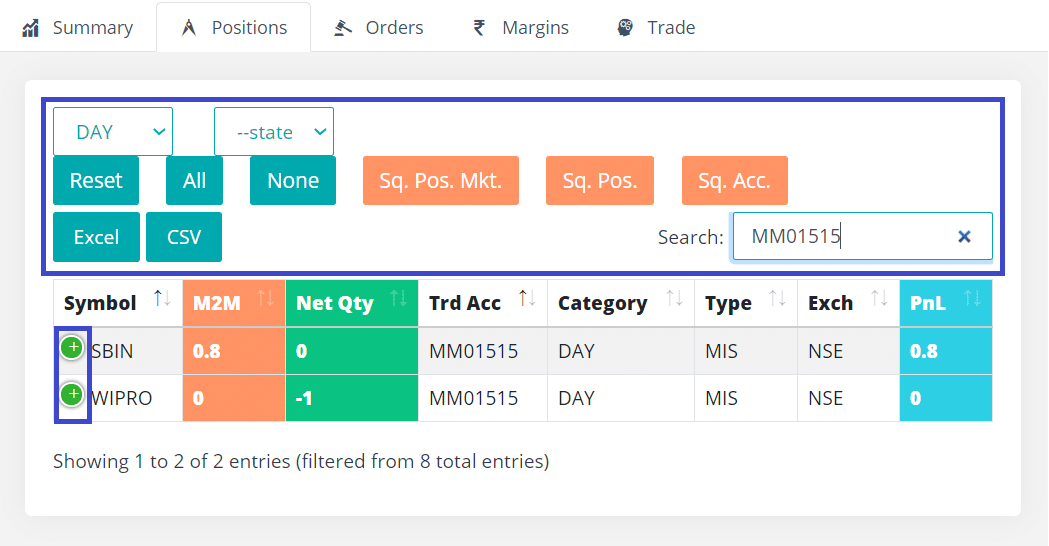
To see the complete details of a specific position, click the plus (+) sign at the start of the row. You can also use the options below.
Summary panel
At the top of the Positions tab is a summary panel (collapsed by default — click it to expand). It is calculated from the rows currently shown, so your filters affect it. It shows:
- Quick numbers: M2M (with open and closed counts), PnL (realised + open), AT PnL, and the Total number of positions across your accounts.
- When expanded: a Direction breakdown (Long / Short / Neutral) and a Net Qty split (Long vs Short).
Columns
Each row is one position. You can show, hide, reorder and sort columns (see Column ordering and sorting below). For derivatives, quantity is also shown in lots next to the raw quantity.
| Column | Meaning |
|---|---|
| Symbol | The trading symbol (broker-independent). |
| M2M | Mark-to-market profit or loss for today. For a position carried from an earlier day it is measured from yesterday’s closing price, so it is not the same as your total profit or loss (see PnL below). |
| PnL | Your total profit or loss on the position, measured from the price you bought or sold at. Usually reported by your broker; for some accounts our system works it out (see PnL below). |
| AT PnL | Profit or loss calculated by our system (see PnL below). |
| AT PnL Live | A live profit/loss estimate that keeps ticking with the market. It uses a different calculation from AT PnL (see PnL below), so the two can differ slightly. |
| Real PL | Realised (booked) profit or loss. |
| Unreal PL | Unrealised (open) profit or loss. |
| Net Qty | Net position quantity (buy minus sell). |
| Ltp | Last traded price. Updates live. |
| Nickname | The nickname (pseudo account) of the trading account. |
| Trd Acc | The trading account (login id). |
| Buy Qty / Sell Qty | Total quantity bought / sold. |
| Buy Val / Sell Val | Total buy / sell value. |
| Net Val | Net value of the position. |
| B Avg Prc / S Avg Prc | Average buy / sell price. |
| State | OPEN or CLOSED (closed means net quantity is zero). |
| Direction | LONG or SHORT. |
| Type | Product type of the position (for example intraday, delivery or normal). |
| Category | DAY or NET. A DAY position is today’s trading only; a NET position includes what you carried in from earlier days. |
| Broker | The broker for this account. |
| Overnight Qty | Quantity carried over from the previous day. |
| Multiplier | Quantity multiplier for the instrument. |
| Exch | Standard exchange code. |
| Br Exch / Br Symbol | Exchange and symbol as named by the broker. |
| Day | Whether this is a day (intraday) position. |
| Platform | The broker platform used. |
| Acc Id / Id | Internal account id / position id (useful when you contact support). |
PnL
Several columns show profit and loss (see the Columns table above). M2M and PnL usually come straight from your broker, while AT PnL (and AT PnL Live) are worked out by our own system. Because the two are calculated in different ways, and from different data, the numbers can differ.
Zerodha accounts are different. For Zerodha equity and F&O positions, M2M, PnL, Real PL and Unreal PL are worked out by our own system from the live market price, and risk management uses the same figure. Commodity positions still use Zerodha’s figure. See Why is my Zerodha profit or loss different from the Kite app?
M2M and PnL also measure different things. M2M is today’s change, measured from yesterday’s closing price for a position you are carrying. PnL is your total profit or loss since you opened the position. On a position opened today the two are the same number, because there is no previous day to measure from. For a full explanation with an example, see Why AT PnL is different from M2M.
Why we calculate AT PnL
The AT PnL column exists because the PnL we receive from some brokers has these issues:
- Some brokers send delayed PnL.
- Some brokers do not send PnL in the position data at all.
So we calculate our own value. To do this, our system uses your position’s average buy price and average sell price, the overnight quantity carried from the previous day, the live price of the stock or derivative, and the fields and formula the broker provides for working out profit and loss.
Why the numbers can differ
Sometimes the data the broker sends is not enough to match their figure exactly. This is more common for overnight derivative positions, where the data can be inaccurate or incomplete, or the broker does not publish the exact formula they use. In those cases our calculated value can differ a little from the value on the broker’s own screen.
This calculation is still in BETA. If you see a profit or loss value that looks wrong, please report it to us so we can check it and fix it.
AT PnL Live
The AT PnL Live column is a live estimate that keeps ticking with the market. It starts from a baseline profit/loss and adjusts it for how the price has moved since the last data refresh. It uses a different calculation from AT PnL, so the two values can differ slightly.
Position Category
Your stock broker returns position data in two separate sets.
- DAY – a snapshot of the buying and selling activity for that particular day. This is useful for computing intraday profits and losses for trading strategies.
- NET – the actual current net position portfolio, or day plus overnight.
By default, the system shows NET positions, but you can always filter it as per your needs.
Position State
The state buttons above the table let you filter positions by OPEN, CLOSED or ALL. The state is decided only from the net quantity. For BO and CO positions, please also check for open child orders (target and stop-loss orders).
More filters
Two more drop-downs sit next to the state buttons:
- Category – show Equity or Commodity positions. (This is different from the DAY and NET data sets described above.)
- Direction – show Long or Short positions.
Reset
This button clears all filters (including the search text) and resets the table to its default view.
Square-off Positions
There are three square-off buttons:
- Sq-off (Market) – square off the selected positions at market price.
- Sq-off (Custom) – square off with your own quantity and price.
- Sq-off Acc – square off whole accounts in one click (see Square-off Account).
To understand how square-off works internally, read the square-off process.
Square-off at market price — Sq-off (Market)
- Select one or more positions and click Sq-off (Market).
- It squares off the positions at market price.
- All types (MIS, CNC, NRML, BO, CO) of positions can be squared off.
- A confirmation appears with a “Cancel all OPEN orders for this position” option (ticked by default), so any pending orders for that position are cancelled at the same time.
- When it finishes, a results window shows the outcome for each account.
Square-off with custom options — Sq-off (Custom)
- Select one or more OPEN positions and click Sq-off (Custom).
- It opens the Trade tab with a reverse (square-off) order pre-filled, so you can set your own quantity and price.
- You can specify the quantity as well as the price for the square-off order.
- Only MIS, CNC and NRML positions can use custom square-off — Bracket (BO) and Cover (CO) positions are not allowed.
- Use the Reset button on the Trade tab to bring the screen back to normal order entry.
- After you place the square-off, the Trade tab keeps the symbol so you can trade it again, and goes back to normal order entry.
- A line next to the BUY/SELL button tells you what happened: green if it was placed, red if it failed, amber if only some accounts went through.
- If every account rejected the square-off, nothing was placed. The square-off order stays filled in, so you can retry with one click.
- If you place the same side on the same symbol within 10 seconds, we ask before sending it again.
This is also how you put a stop-loss or a target on a position you already hold. Because Sq-off (Custom) hands you the reverse order already filled in, you only have to change the Order Type: pick STOP_LOSS or SL_MARKET and set a Trigger Price for a stop-loss, or LIMIT and set a Price for a target. Then place it as a resting order instead of squaring off at market. See How do I set a stop-loss or a target? for all three ways to do this.
Note: Only the fields highlighted below are enabled for editing. Modifying other fields is not valid during square-off. For example, if you are squaring off a WIPRO position, you would not want to change the symbol by mistake. So many fields that should not be modified are disabled.
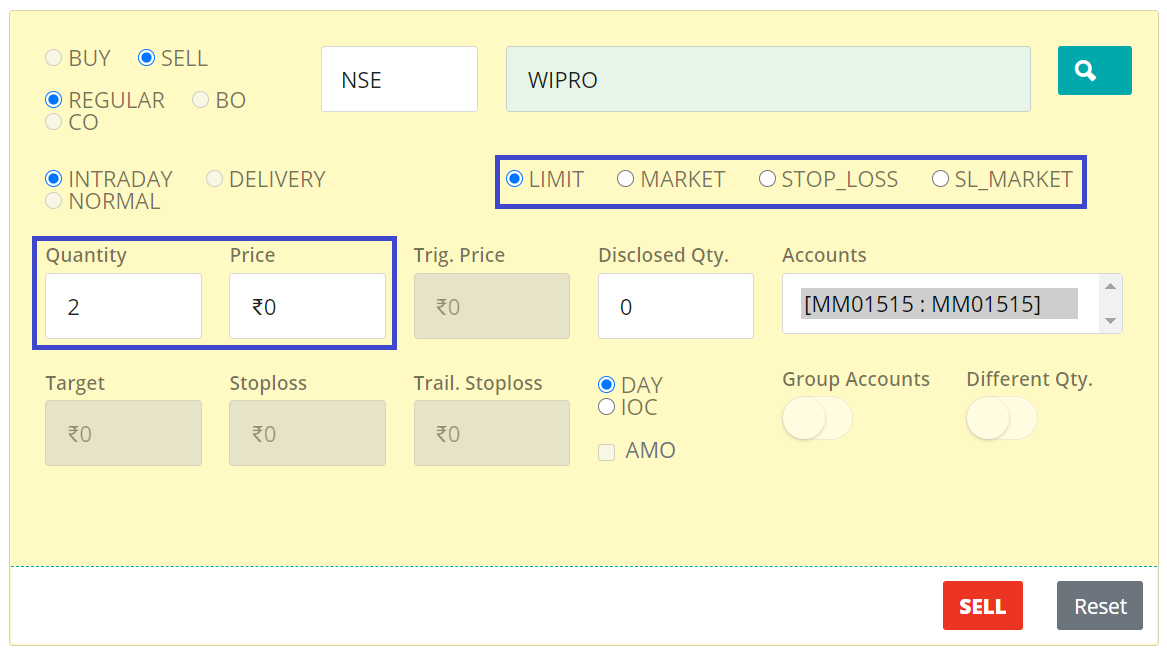
Custom positions square-off screen.
Internal Working
It is very important to understand how AutoTrader Web’s square-off works. The details are given on the square-off process page.
Square-off Account
Click Sq-off Acc to square off entire accounts in one click. A window opens where you:
- Pick one or more accounts (with Select-all / Clear helpers).
- Turn on Group Acc to treat a group as a single account.
- Choose the Category — DAY or NET (keep it on NET if you are not sure).
- Keep Cancel open orders on (the default) to cancel pending orders before the square-off starts.
The system then squares off all open positions in the accounts you selected, and shows the outcome for each account.
How much this will close
Squaring off a whole account is a big step, so the window tells you what it covers before you press the button — for example, “3 open NET positions across 2 accounts will be squared off”, with a per-account breakdown underneath. It updates as you change the accounts or the category.
The count is worked out from the rows loaded in the Positions tab, and the window is honest about that:
- If the Positions tab is showing only some of the accounts you picked, the line says so (for example, “across 1 of 2 accounts”) and warns you that the accounts it could not count will still be squared off.
- If you turned on Group Acc, no count is shown at all. It tells you plainly that every open position in the selected groups will be squared off, rather than showing a number it cannot stand behind.
A wrong count here would be worse than no count, so it never guesses.
Moving the window
You can move this window out of the way. Drag it by its title bar and it stays where you put it, including the next time you open it on that same computer. Once you have moved it, a small ⌖ button appears in the title bar — click it, or double-click the title bar, to put the window back in its usual place. It can never be dragged off the edge of the screen, so it cannot get lost.
Because the window can be moved, clicking outside it no longer closes it. Use Cancel or the ESC key to close it.
Increase Positions
Use the Increase button to add to (increase) one or more selected positions. This places a new order in the same direction as the position: a buy order for long positions, or a sell order for short positions. (Square-off does the opposite — it reduces or closes a position.)
- Select one or more OPEN positions and click Increase.
- It opens the Trade tab with a same-direction order pre-filled, so you can set your own quantity and price.
- The symbol, product type and accounts are filled in from the selected positions and locked, so you only enter the quantity (and price). This avoids changing the wrong field by mistake.
- All the selected positions must be the same symbol and the same type, and all must be in the same direction — all long, or all short. Bracket (BO) and Cover (CO) positions cannot be increased.
- You can increase across several accounts at once, using the same quantity for all accounts or a different quantity per account.
- Use the Reset button on the Trade tab to bring the screen back to normal order entry.
AutoTrader bracket and cover orders (AT_BO / AT_CO)
If a position came from an AutoTrader bracket or cover order, it carries a small AT_BO or AT_CO pill next to its symbol, with a little arrow (▾) on it. This is where your target and stop-loss live — a bracket does not appear as separate target and stop-loss orders in the order book, so there is nothing to look for there.
- A solid pill means your entry has filled and your levels are being watched. A faded pill means the entry has not filled yet, so nothing is protected yet.
- When it is solid, your live stop-loss is printed next to the pill, so you can read it without clicking.
- A Closed pill means the bracket finished today. Next to it is what happened — for example Target hit — exited at 1,227.70, or Squared off at 3:00 PM.
Click the pill and the row opens to show the status, quantity, entry price, target, stop-loss, trailing step, the time the position squares off, and where your stop-loss is being kept — resting at your broker as a real order, or watched by us.
Three buttons sit in that panel:
- Modify — change your target, stop-loss or trailing step. You type the price you want, not a distance, and any box you leave empty is left alone.
- Remove protection — stop watching one or more of your levels. This does not close your position. You choose whether to drop the target, the stop-loss, the trailing, or everything.
- Exit now — close the position at market straight away. If the entry has not filled yet, it cancels that waiting order instead.
A closed bracket has no buttons — there is nothing left to act on.
For the full walkthrough see how to see, change, exit or stop watching an AT_BO or AT_CO.
The same pill appears on the Orders tab against the order that started the bracket, but there it is for looking only. The three buttons are here, on Positions.
Search
You can search positions by entering text in the search box. For example, you can search by symbol or account.
Pages on large screens
If the screen has more than about 1,000 positions, it is shown in pages of 100 positions, with page buttons below the table. This keeps the screen quick to open. With fewer positions, everything stays on one page as before.
Nothing is hidden by this. Select, the totals, the search box and the Excel or CSV export all still work on every position that matches your filter, across all pages. See why the screen shows pages.
Selecting Positions
To select one or more positions, click on the position row. Click again to deselect.
The Select button selects every position that matches your current filter, on every page — not only the page you are looking at. Positions hidden by a filter are not selected.
- To select only OPEN positions, first filter open positions using the state buttons, then click Select.
- To select all positions of a specific account, first enter that account number in the search box, then click Select.
- To select all positions of one symbol, choose that symbol in the filter box under the Symbol column heading, then click Select.
The Deselect button clears the selection on all pages.
The fast way to pick many positions
If you have many positions and want to act on a group of them, do not click each row. Filter first, then select:
- Set the filter box under a column heading. For example, set Symbol to
SBIN. - Click Select. It takes every position left after your filter, on every page.
- Click Sq-off or Increase.
You can filter more than one column at the same time, so you can narrow the list down as much as you need.
If you start clicking rows one at a time, the screen will show you this shortcut and mark the filter box to use. It appears only when filtering would clearly save you time, so you will not see it on a short list. On a long list, a shorter version stays in the bottom left corner, so you can still read it after you have scrolled down. It only tells you — it never changes your filters or your selection. Click Got it, hide this for now to put it away; it stays hidden for 30 days.
If you do not see the filter boxes under the column headings, switch on Column Filters in Settings -> General.
Column ordering and sorting
Based on user feedback, we added custom column ordering and sorting for the portfolio tables: positions, orders, margins and holdings.
- You can rearrange the columns by clicking on a column header and dragging it.
- You can also apply sorting for your preferred column.
Note: These settings are saved to your account, so your column order and sorting stay the same even when you sign in from another computer, mobile or browser.
We strongly recommend going through our PMS (Portfolio Management System) tool.
Frequently asked questions
Why does M2M show a loss when my position is in overall profit?▾
M2M is only today's change. For a position carried from an earlier day it is measured from yesterday's closing price, not the price you bought at — so if the price slips a little today, M2M can read negative even while you are in profit overall. Your total profit or loss is the PnL column, which matches the Gain or Loss shown on your broker's own terminal. (In the app you can hover the M2M or PnL column header for a quick reminder of what each one means.)
Can I add to (increase) an existing position?▾
Yes. On the Positions tab, select one or more open positions and click Increase. It opens the Trade tab with a same-direction order pre-filled (buy for long positions, sell for short), so you set your own quantity and price. You can do it across several accounts at once.
Where is the target and stop-loss for my AT_BO or AT_CO position?▾
On this screen, on the pill next to the symbol. A position from an AutoTrader bracket or cover order carries a small AT_BO or AT_CO pill with a little arrow on it, and when your entry has filled your stop-loss is printed next to it. Click the pill and the row opens to show your entry price, target, stop-loss, trailing step and where the stop-loss is being kept, along with buttons to change your levels, stop watching them, or exit. They are not separate orders, so there is nothing to look for in the order book.
Next steps
Thanks for the feedback. Still stuck? Contact support.
Last updated 8 October 2026