Nuvama
Add and validate your Nuvama account in AutoTrader Web.
To use Nuvama with AutoTrader Web, do three things. First, create an API app in the Nuvama API Dashboard to get your App API Key and App Secret Key. Second, enable TOTP in your Nuvama profile and save the TOTP secret key. Third, add the account in AutoTrader Web under Accounts -> Trading Accounts using platform NUVAMA_RETAIL.
This page shows how to set up a Nuvama account with AutoTrader Web. See the full list of supported brokers for other brokers.
Demo video
Step 1: Create the API app
- Login to the Nuvama API Dashboard.
- Click Create New App and enter these values:
- App Name:
MyTradingApp - Redirect URL:
https://webx.stocksdeveloper.in/auth/nuvama
- App Name:
- After you create the app, you get an App API Key and an App Secret Key. Nuvama sends them by email and also shows them in the API dashboard.
Step 2: Enable TOTP and get the key
- Login to Nuvama Wealth.
- Click the User icon at the top right corner, then click See Profile.
- You will see an option to Enable TOTP.
If TOTP is already enabled but you do not have the TOTP key, disable it and enable it again.
On the Enable TOTP screen, follow these steps:
- IMPORTANT: Just below the QR code there is a link (Click here to copy the key). Click it to copy the key and save it in Notepad. You will need it later.
- Open any authenticator app on your smartphone, such as Google Authenticator, Microsoft Authenticator, or Authy.
- Click Scan a QR code under the Add an Account section and allow camera access. You should now see the TOTP for Nuvama in the authenticator app.
- Enter your Nuvama password first.
- Enter the TOTP shown in the authenticator app.
- Click Enable. Your TOTP is now set up.
Note: Only after TOTP is enabled should you move to the next step.
Step 3: Add your account in AutoTrader Web
- In AutoTrader Web, open the menu (Accounts -> Trading Accounts).
- If you are adding the account for the first time, click the Create button. If the account already exists, click the small EDIT icon next to your Nuvama account’s client id or login id.
- Fill in these fields:
- Select broker Nuvama
- Select platform NUVAMA_RETAIL
- Enter your Nuvama login id
- Enter your Nuvama password
- Enter your TOTP secret key
- Enter your App API Key
- Enter your App Secret Key
- Click the Validate button.
- On successful validation, click save to add the account.
That is it. Your Nuvama account is now added. Do not forget to read the known limitations.
Screenshot
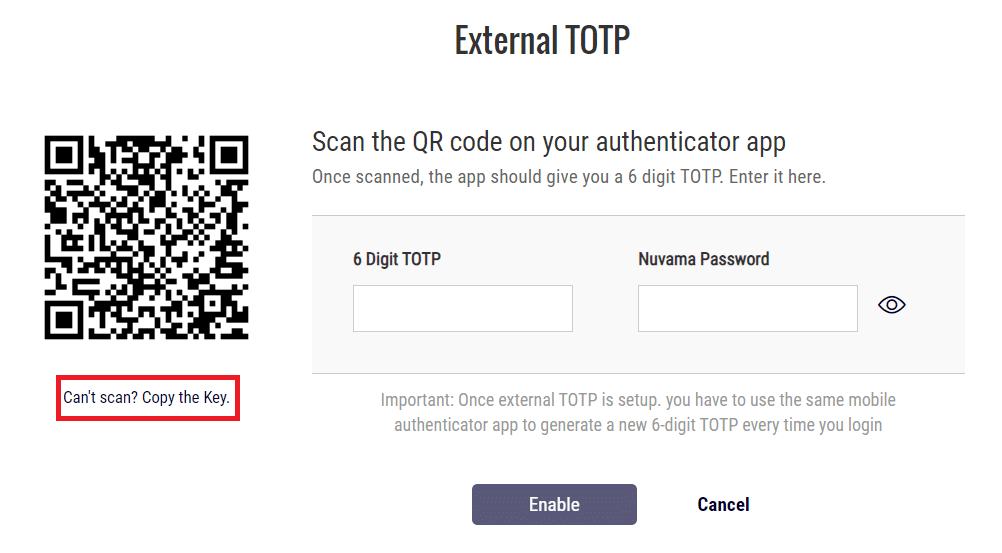
Enable TOTP Screen – Nuvama
Static IP Setup
The static IP setup is the same for every broker. Follow the full guide here:
→ Static IP Setup — set up a static IP or bring your own (BYOIP)
Bracket and cover orders on Nuvama
Nuvama offers bracket and cover orders of its own, and you can carry on using them — they are still in the Variety list and nothing about them changes. AutoTrader has its own versions too, and they are worth knowing about because they behave the same way on every broker you trade.
An AutoTrader bracket order (AT_BO) attaches a target and a stop-loss to your Nuvama order, with an optional trailing stop that follows the price in your favour and never moves back. An AutoTrader cover order (AT_CO) is the same thing with a stop-loss only. Your entry reaches Nuvama as an ordinary intraday order, and AutoTrader Web watches the price and sends the closing order when your level is reached. Use it when you want a trailing stop that behaves identically across brokers, when you want to change your levels after placing, or when you trade several brokers and want one set of rules.
Place one from the order window, from your own code, or from a chart alert. It is intraday only, it does not give you the extra intraday margin some brokers give on their own bracket orders, and the position is squared off automatically a short while before the market closes.
Read the risk before you use it. A stop-loss decides when we try to exit — it does not decide the price you get. A sudden move can take the price straight past your level, so your loss can be larger than the stop-loss you set. The full explanation, and the one-time terms you agree to before your first one, are on Bracket & Cover Orders.
Frequently asked questions
Does AutoTrader Web support Nuvama?▾
Yes. Nuvama is fully supported. You can connect one or many Nuvama accounts and monitor live P&L, holdings and positions, place and manage orders, and copy trade across all of them from one screen, on web or mobile.
Can I copy trade with Nuvama?▾
Yes. You can copy trade with Nuvama in two ways — PMS copy from our terminal and master-child copy in the background — across accounts and brokers, with per-account sizing. You set up and control everything.
Can I manage multiple Nuvama accounts together?▾
Yes. Add as many Nuvama accounts as you like and see consolidated P&L, holdings and positions live, and trade across all of them at once.
How much does it cost to use Nuvama with AutoTrader Web?▾
AutoTrader Web is ₹295 to ₹495 per account per month, with all taxes included, and a free 1-month trial. Your account also needs a static IP — this is required for every broker, not optional. You can buy a Premium static IP (₹250 per month, faster and a little more reliable), take a Standard static IP (₹150 per month), or bring your own IP for free — all prices include tax. If Nuvama charges separately for API access, that fee is set by the broker.
Can I place a bracket order on Nuvama?▾
Yes, in two ways. You can use Nuvama's own bracket and cover orders, which are unchanged, or an AutoTrader bracket order (AT_BO) or cover order (AT_CO), which behave the same way on every broker. Ours adds a trailing stop everywhere and lets you change your target and stop-loss after placing. It is intraday only and gives no extra margin, and a sudden price move can still take your exit past the level you set.
Next steps
Thanks for the feedback. Still stuck? Contact support.
Last updated 8 October 2026